Posts

Showing posts with the label Heat Map

Streaming Big Data For Heatmap Visualization using Storm

A record number of tweets was set during the 2012 Presidential debate. If you wondered how technologically this happened, then Event Stream Processing is your answer. Actually, Twitter open sourced such an implementation called Storm . Pretty impressive piece of technology! So, I wanted to try it out with a "geo" twist. To get started, I recommend that you read " Getting Started with Storm ".  Here is the challenge at hand, simulate a stream of aircraft flight track targets, in such that a heatmap is generated based on the density of targets at "near" locations. The topology is very simple in this challenge, a spout reading the targets from an external source (to be defined later) is linked to a bolt that overlays a virtual grid on top of an area of interest.  Each emitted target tuple is mapped to a cell in the grid and the cell weight is decreased or increased when the target leaves or enters a cell. Storm is a distributed system, that means that...
Heat Map Layer Revisited

Image
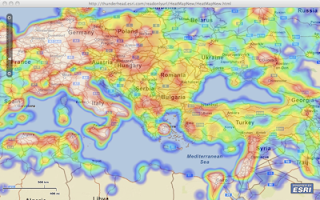
Following this post, Glenn G. found an "issue" when panning the map. I revisited the project and indeed there was a bug. Thanks Glenn. I updated the project and here is the result. In this project, I downloaded from geonames all cities with population over 15000 and plotted them on the map. The clustering of the cities (over 21,000) generated a cool heat map. Check it out and tell me what you think. And like usual, you can download the source code from here .

Spatial / Temporal MBTA HeatMap

MassDOT issued a visualization challenge , where it is calling on developers to use released CharlieCard data to visualize "A Day in the Life of the MBTA". The following three applications use the Flex API for ArcGIS as a response to this challenge. The first application (click here to view it) consists of two maps. The first map contains a dynamically generated heat layer that morphs based on the selected hour. The second map is an isometric projection, but the T lines are represented in a schematic layout rather than a geographical layout. A schematic layout is what you see when you step up to a metro map at the station. You, the user, can rotate the schematic map by holding down the left mouse and dragging it left or right (no zoom in, sorry). At the bottom of the application is a horizontal slider. As you drag the slider, you are changing the "current" hour and minutes of the day. On the geographic map, the heat layer will reflect the CharlieCard counts per st...

Yet Another Heat Map

Image
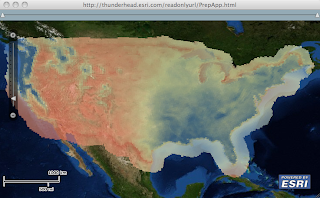
While in Redlands last week, I was working with a client on how to create a heat map of an annual precipitation data over the US. He had about 11.5K map points with precipitation values and wanted to render this data very efficiently on the client browser using the new Flex API and wanted to have control over the rendering criteria. We loaded the data onto SqlServer and fronted it with WebORB (since he was a .Net dude, I'm a Java dude and would have used BlazeDS ) to enable RemoteObject interaction. The idea here is to bulk load the data using SQL onto some structure and AMF it to the client. On the client side, we take advantage of that structure and use the Flash graphic primitives to render it. Turn out the most efficient structure is composed of 3 arrays holding the x, y and precipitation values. Since on the client we did not need to interact with each value, I created a custom layer that sub-classes Layer to render the 11 thousand values on a bitmap, and then the bitmap is...

Heat Map + Papervision3D

Image
Doug McCune (one of my all time Flex heroes) contributed heavily to SpatialKey , which looks and works great. Got to see it last week at 360|Flex in San Jose. I've been wanting to do something similar, but in 3D! Dabbled a bit with Papervision3D , but wanted to get into it, and that was the perfect opportunity. The idea that I had was to read a country shapefile , and thematically map all the cities in that country based on some attribute. And do all that on the client using Flex. I did a little bit of research, and here is a list of sites that "inspired" me: http://blog.papervision3d.org/ http://code.google.com/p/vanrijkom-flashlibs/ http://www.darronschall.com/weblog/archives/000273.cfm http://www.seld.be/ http://blog.zupko.info/?p=150 And here is a snapshot of the result: You can download the source code of the application from here . And you can see a sample demo here .